



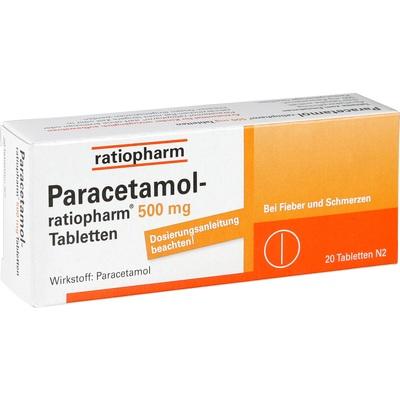
PARACETAMOL-ratiopharm 500 mg Tabletten
£2.34*
£3.76* You save £1.42| Packing Size: |
 20 St
20 St
|
|---|---|
| Dosage Form: |
 Tabletten
|
| PZN: |
 01126111
|
| Manufacturer: |
 ratiopharm GmbH
|
| properties.row.pdf-link: | properties.row.pdf-download |
In Stock
- Leichte bis mäßig starke Schmerzen, wie: - Kopfschmerzen - Regelschmerzen - Zahnschmerzen- Fieber
Application InfoTaking the medication on an empty stomach promotes faster onset of action. Patients with impaired liver/kidney function or Gilbert's (Meulengracht) syndrome: You may need to reduce the individual/total dose or extend the dosing interval in consultation with your doctor.
Application NotesThe total dose should not be exceeded without consulting a doctor or pharmacist. How to use? Take the medicine with liquid (e.g., 1 glass of water). How long should it be used? Do not use the medicine for more than 3 days without medical advice. If symptoms persist or recur regularly, consult your doctor. Overdose? A variety of overdose symptoms may occur, including nausea, vomiting, sweating, drowsiness, and hepatic coma. If you suspect an overdose, contact a doctor immediately. Missed a dose? Continue taking the medicine as normal at the next scheduled time (do not double the dose). General advice: Pay particular attention to accurate dosing, especially for infants, young children, and the elderly. If in doubt, ask your doctor or pharmacist about any possible effects or precautions. A doctor's prescribed dosage may differ from the information in the package leaflet. Since the doctor tailors the dosage to your individual needs, you should use the medicine according to their instructions.
DosageChildren aged 4-8 years weighing 17-25 kg: 1/2 tablet; Children aged 4-8 years weighing 17-25 kg: every 6 hours, regardless of meals; Children aged 8-11 years weighing 26-32 kg: 1/2 tablet; Children aged 8-11 years weighing 26-32 kg: every 6 hours, regardless of meals; Children aged 11-12 years weighing 33-43 kg: 1 tablet; Children aged 11-12 years weighing 33-43 kg: every 6 hours, regardless of meals; Adolescents aged 12 years and older and adults weighing 43 kg and over: 1-2 tablets; Adolescents aged 12 years and older and adults weighing 43 kg and over: every 6 hours, regardless of meals
What side effects can occur? Only side effects that have occurred in exceptional cases have been described for this medication. If you notice any discomfort or changes in your condition during treatment, contact your doctor or pharmacist. The information provided here primarily considers side effects that occur in at least one in 1,000 treated patients.
ContraindicationWhat are the contraindications? Always: - Hypersensitivity to the ingredients. Under certain circumstances - consult your doctor or pharmacist: - Impaired liver function (e.g., due to chronic alcohol abuse or hepatitis) - Alcohol abuse - Impaired kidney function - Gilbert's syndrome (Meulengracht's disease) - Hereditary enzyme disorder (glucose-6-phosphate dehydrogenase deficiency) - Anemia due to rapid breakdown of red blood cells (hemolytic anemia) - Glutathione deficiency - Dehydration - Malnutrition. Which age group should be considered? - Children under 4 years: This medicine should generally not be used in this age group. There are preparations that are more suitable in terms of strength and/or dosage form. What about pregnancy and breastfeeding? - Pregnancy: Consult your doctor. Several factors play a role in determining whether and how this medication can be used during pregnancy. - Breastfeeding: According to current knowledge, there is no evidence that this medication should not be used while breastfeeding. If this medication has been prescribed to you despite a contraindication, talk to your doctor or pharmacist. The therapeutic benefit may outweigh the risk associated with using the medication despite the contraindication.
Important NotesWhat should you be aware of? - Do not use for longer than indicated in the package leaflet without consulting a doctor if you have pain or fever! - Prolonged use of painkillers can cause headaches that are themselves caused by the painkiller. Talk to your doctor to prevent your headaches from becoming chronic. - Habitual use of painkillers can lead to permanent kidney damage. This risk increases if several painkillers are combined or if a single painkiller contains multiple active ingredients. - Caution: Regular or heavy alcohol consumption can lead to life-threatening conditions if this medication is used in conjunction with pre-existing liver damage. - Caution if you are allergic to painkillers! - Caution if you are allergic to binders (e.g., carboxymethylcellulose with the E number E 466)! - Drug interactions are possible. Therefore, you should always inform your doctor or pharmacist about any other medications you are currently taking before starting treatment with a new medication. This also applies to medications you buy yourself, use only occasionally, or whose use was some time ago.